
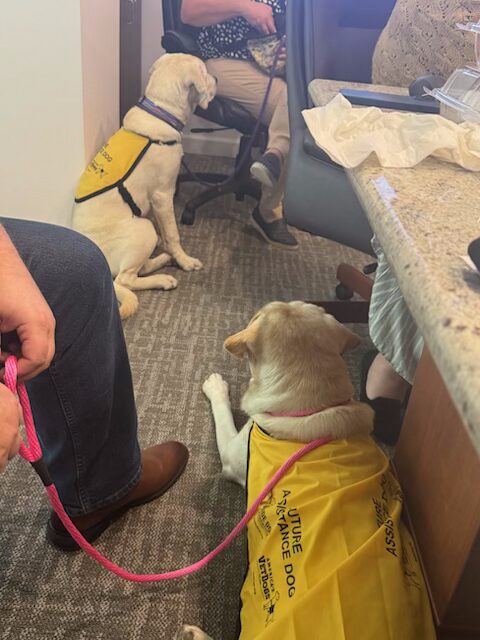
BRAWW recently welcomed a unique pair of visitors to our office: Lemon and Hudson, two guide-dog-in-training from the Guide Dog Foundation, along with Catherine, the daughter of firm administrator Adam Hentz, who led an engaging Lunch & Learn session about the organization’s mission and the life-changing impact of guide dogs.
Catherine and her family have fostered and raised more than a dozen guide dogs over the years, providing early socialization and foundational training that prepare these dogs for a lifetime of service. Her presentation offered an inspiring look at what it takes to raise a future guide dog, why this work matters, and how these highly trained animals become essential partners for people who are blind or visually impaired.
A Legacy of Service
Founded in 1946 to support returning World War II veterans, the Guide Dog Foundation has spent nearly 80 years training and placing guide dogs, all at no cost to the individuals who rely on them. Today, their Smithtown, New York campus includes a student residence, a state-of-the-art training center, and a celebrated breeding program that produces the Labrador Retrievers and Golden Retrievers most commonly used as guide dogs.
Breeding, raising, and training one assistance dog can cost more than $50,000, yet those who need a guide dog never receive a bill. Funding comes entirely from donations, corporate support, and community partners.
How Puppy Raisers Make It Possible
Puppy raisers like Catherine and her mother, Robin, are the heartbeat of the Foundation. Puppies enter foster homes between 8-12 weeks old and stay for roughly 14-18 months before returning for formal training. Raisers introduce the dogs to the world by visiting grocery stores, offices, sidewalks, and public transit, and teach confidence, socialization, house manners, and basic cues.
Their family has helped raise an extraordinary number of dogs, many of whom have gone on to remarkable careers:
- Captain – now an Arson Accelerant Detection K9 for the ATF
- Aspen – in training as a bomb-sniffing canine
- Cleo – a bomb detection K9 in Las Vegas
- Warren, Pat, and others – working guide dogs or service dogs
- Jetty & Janie – selected as breeders, the highest honor a dog can receive
Lemon and Hudson, the two puppies who joined us for the visit, are still early in their training journeys but already stealing hearts everywhere they go.
The Etiquette Everyone Should Know
Catherine also shared helpful reminders about how to interact respectfully and safely around guide dogs and their handlers. The most important rule: if a guide dog is working (wearing a harness), don’t touch, talk to, or distract the dog. The handler depends on the dog’s focus to navigate safely.
Additional best practices include:
- Never grab a handler or the dog’s harness; always ask if they want assistance.
- Offer your arm rather than pulling or guiding physically.
- Speak directly to the person, not to the dog or the person accompanying them.
These guidelines protect both the dog and the handler, ensuring the team can move confidently through public spaces.

Supporting Veterans Through America’s VetDogs
Catherine also highlighted America’s VetDogs, an affiliated program created in 2003 to provide trained service dogs to military veterans and first responders. These dogs learn more than 200 specialized tasks, from retrievals to bracing to opening doors, helping recipients regain independence and mobility.
The organization’s “Puppy With a Purpose®” partnerships have brought national attention to their mission through collaborations with NBC’s TODAY Show, professional sports teams, and major corporations.
Why This Work Matters
Guide dogs don’t just help their handlers get from place to place. They offer freedom, confidence, safety, and companionship. For many visually impaired individuals, a guide dog is a transformative partner, one who makes school, work, and independent living possible.
We’re grateful to Catherine, Lemon, and Hudson for sharing their time and expertise with our team, and to the Guide Dog Foundation and America’s VetDogs for the incredible work they do every day. BRAWW is proud to support community education efforts like these and to spotlight organizations helping people live fuller, safer, and more independent lives.